November 24, 1971 — Portland International Airport, Oregon
It was the kind of November evening that made people hurry inside. The sky over Portland hung low; dark and bruised, a cold drizzle slicking the parking lot outside the terminal. Umbrellas floated above people, as a mysterious man walked into the Portland International Airport. Inside, the lights of the departures hall cast long reflections on the waxed linoleum floor. Families gathered near the counters, their laughter muffled by the constant drone of announcements and rolling luggage.
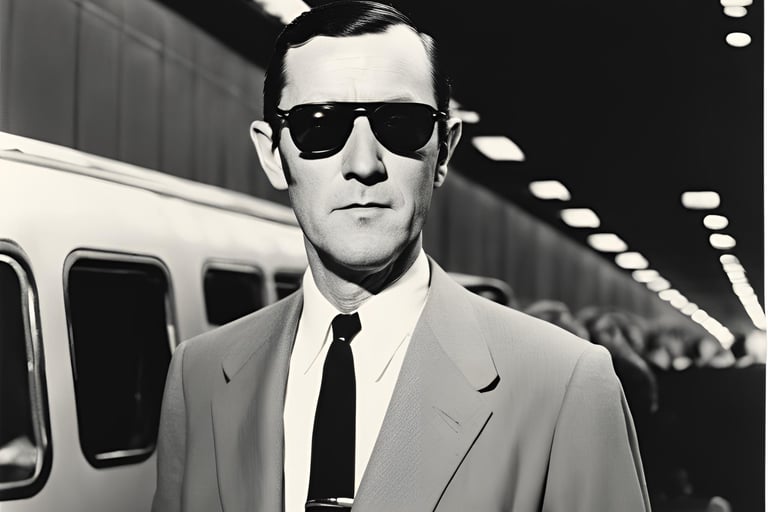
He walked in, unnoticed at first. A man in a pressed black suit and narrow tie, shoes polished to a shine that reflected the fluorescent glare, not unlike the boots of a recruit in basic training. He carried a single black briefcase in one hand and wore dark sunglasses that looked out of place under the terminal’s dim glow. If anyone looked twice, they might have guessed businessman. Or an accountant. Maybe a traveling insurance salesman heading home from a last-minute run before Thanksgiving.
At the Northwest Orient Airlines counter, the man paused. He placed the briefcase gently on the counter and spoke with a voice that was calm, almost polite.
“One ticket. One way. To Seattle.”
The clerk barely glanced up. It was a short hop, barely half an hour in the air — a routine run dozens of times each day. The kind of flight that bored pilots fly. She asked for his name.
“Dan Cooper.”
She wrote it down, typed his ticket. He paid in cash; a little more than twenty dollars, the bills folded crisp inside his breast pocket. He pocketed the stub, retrieved his briefcase, and with a courteous nod, drifted toward Gate 52 like he’d done it a thousand times before.
***
Florence Schaffner stood just inside the door of the plane, her navy-blue uniformed crisp, and hair in a tight bun. For Florence, this was her tiny thrill; her first glimpse at the passengers of the day. She straightened her uniform jacket and smoothed back a strand of hair that kept escaping her bun. She’d been flying for two years, but every time she stepped onto a plane, she secretly loved the thrill of the hush before takeoff, the hidden conversations between strangers pressed close in the narrow cabin.
Flight 305 that night should have been easy, but any flight attendant or restraint server will tell you it just takes one passenger, or restaurant to derail an easy night. Thirty-six passengers, a short route north to Seattle, clear weather. Then she’d be back on the ground before midnight, maybe call her boyfriend before turning in at the motel.
She watched the man in the sunglasses approach. An intriguing individual, almost unnoticeable as he moved with deliberate calm, as if the world around him was background noise. For a moment, their eyes met — or rather, her eyes and the lenses of his sunglasses. She felt a tiny flicker of something. Unreadable. Little did she know that she had just met the man who was going to derail her evening.
He gave her a nod, stepped inside the cabin, and slipped into seat 18C. Some records would say 18E — the truth would get muddled quickly, but right then it didn’t matter. He stowed his briefcase beside his polished shoes and settled back like a man who knew exactly what he was doing: he was a man with a plan, and so far there was nothing standing in his way.
***
The engines thrummed as the plane taxied onto the runway. Inside the cabin, passengers leaned back, flipping through newspapers and magazines. Cigarette smoke drifted lazily toward the overhead vents. Florence moved down the aisle with her practiced smile, checking seatbelts, offering the usual reassurances.
She stopped by 18C when the man in black raised a hand.
“Bourbon and soda, please,” he said. His voice was low, the kind you leaned in to catch. Maybe he needed to calm his nerves before the show.
“Of course, sir,” she replied.
When she returned with the drink on a napkin, he had already lit cigarette. He blew a thin ribbon of smoke that curled toward the overhead light. In that faint moment, Florence noticed the faint smell of cologne, sharp, clean, mixed with the stale odor of burning tobacco.
He thanked her with a polite nod and turned his gaze to the dark window, staring out towards the dark clouds and the occasional flicker of wing lights.
***
It was twenty minutes into the flight when he caught her eye again. She felt his gaze before she saw the note — a small slip of paper he held out between two fingers.
“For you,” he said.
Florence forced a small, but uncomfortable smile. Notes weren’t uncommon. She’d gotten phone numbers scribbled on napkins before, awkward flirts from men who hoped to rendezvous with her later that night because their wives would never know, mistaking professional courtesy for flirting.
She slipped the note into her pocket without looking. She’d read it later, toss it in the trash during cleanup. But the man didn’t look away. He leaned closer. His voice was quiet, just enough for her ears alone.
“Miss,” he said, and this time the politeness was edged with steel. “You’d better read that note.” His voice echoed through her head.
She blinked, puzzled. His tone, like a subtle threat made her stomach tighten in a way that had nothing to do with flirtation. She stepped back half pace, unfolded the paper. The words were neat, precise block letters.
“I have a bomb in my briefcase. I want you to sit beside me.”
Florence’s mouth went dry, her stomach tightened, she wanted to scream. Her eyes flicked to the briefcase, then back to the sunglasses that hid whatever expression might be lurking behind them. For a second, she felt the roar of the engines grow louder, pressing in on her ears.
She forced herself to breathe, forced her lips into a smile she hoped looked professional. She tried not to let her fear and panic show. Her heart raced, sweat beaded on the palms of her hands. She glanced around — rows of passengers, oblivious. A mother flipping pages of a coloring book for her son. A businessman half-asleep, tie loosened.
“Please,” the man said, gesturing to the empty seat beside him.
Her legs moved before her mind caught up. She sat, the vinyl seat cold against her palm as she steadied herself. The man snapped open the briefcase just enough to tilt it her way. Inside: red cylinders, a tangle of wires, something that looked like a battery taped to the lid. Enough to convince her this was no prank.
She swallowed. Her mind ran through the training, the handbook phrases. Stay calm. Comply. Relay demands.
He leaned closer. She smelled the bourbon, the cigarette, the faint leather scent of the briefcase.
“Here’s what you’re going to do,” he said, voice low and steady — terrifying in its softness. “You’re going to tell the captain exactly what I want.”
And above them, Flight 305 hummed northward into the night, its passengers blissfully unaware that a quiet stranger in seat 18C had just changed their lives — and American aviation — forever.
***
Somewhere over Puget Sound the hum of the engines filled the cabin like a steady heartbeat. Outside, the sky was a dark, and the Boeing 727 carving a path through mist and drizzle. The passengers behind the cockpit door still slept or read, completely unaware that thirty feet away, a bomb sat under a stranger’s polished shoes.
Florence Schaffner sat stiffly beside Cooper, her notepad resting on her lap. She gripped her pen so tightly her knuckles had gone white. She didn’t dare look directly at him for long, but she forced herself to nod as he explained what he wanted.
His demands were simple: $200,000 in cash — unmarked twenties, bundled and easy to carry. Four parachutes — two main, two reserve. And finally, a fuel truck waiting on the tarmac in Seattle to top them off to head off to Mexico.
He spoke as if reading a grocery list. There was no tremor in his voice, no sign of nerves or anxiety. Florence found herself wondering if he had done this before — or something like it. How much practice does it take before you remove all the emotion from your voice?
She excused herself to pass the note to the cockpit. As she stood, her knees wobbled. She almost fell. She forced her smile back into place when a passenger in row 15 looked up, sensing something was off. She nodded at him — just turbulence, she wanted to say. Just another ordinary flight.
***
In the cockpit, Captain William Scott turned in his seat when Florence stepped in. She closed the door behind her, shutting out the hum of the cabin.
“He says he has a bomb,” she whispered. Her voice cracked. “He wants money. Parachutes. Fuel in Seattle.”
First Officer Bob Rataczak swore under his breath. They exchanged a glance — this wasn’t entirely unheard of. Hijackings in the early ‘70s were nearly weekly news. But bombs — bombs changed things.
Scott lifted the radio mic, thumbed the button. His voice, when he spoke to air traffic control, was calm — clipped, professional.
“Seattle Center, Northwest 305. We have… a situation.”
***
Back in the cabin, Cooper hadn’t moved. He sat exactly as she’d left him, cigarette burning between his fingers. When Florence returned, he gave her a polite nod and gestured for her to sit again.
“Everything all right?” he asked, as if he’d inquired about the coffee.
“They’re arranging it,” she said. She kept her eyes on the seatback in front of her.
Cooper exhaled a thin trail of smoke. He tapped ash into a plastic cup, careful, precise.
“Good,” he said.“Tell them not to play games. Nobody has to get hurt.”
***
Below, at Seattle-Tacoma International Airport, the phones at the Seattle FBI office rang off the hook. News of the hijacking spread fast — agents scribbled notes, flipped open black binders of skyjacker protocols, and called local banks to prepare ransom cash.
At the airport, Northwest Orient’s operations team scrambled to gather the money — twenty-dollar bills, unmarked but with serial numbers recorded in haste. Each stack bound tight with rubber bands. The parachutes came from a local skydiving school — the FBI wanted to slip in dummy chutes, but Cooper had been explicit: four parachutes, implying hostages might be forced to jump too. Any sabotage risked innocent lives, a risk just too great for them.
On the tarmac, ground crews fueled a tanker truck. The drizzle turned into steady rain, soaking agents in trench coats as they huddled near hangars, rehearsing how to deliver the money and stay invisible. This couldn’t go wrong, and even though the agents and ground crews were soaked to the bone in the rain, too many lives depended on this going right.
Inside a cramped conference room, an FBI field supervisor stabbed his finger into a map of Puget Sound.
“Low altitude, short hop — he’s buying time. He’s planned this,” he said. “Who the hell is he?”
No one had an answer.
***
In the cabin time crawled to an almost stop. Florence traded off with Tina Mucklow, another flight attendant, so she could catch her breath in the galley. Tina perched beside Cooper, just as calm. He asked for another bourbon. She brought it, hands trembling.
To her surprise, Cooper made small talk — the weather, how low they were flying, what city she liked best on her routes.
“He was polite,” Tina would later say in interviews. Polite wasn’t the word people expected for a man with a bomb. But that’s how she’d remember him — calm, courteous, never raising his voice.
Occasionally he’d glance at his watch. The minutes ticked on. The passengers grew restless as the plane circled Puget Sound for hours, pretending to have “minor mechanical issues.” They didn’t know that a legend was taking shape three rows away.
***
At 5:39 p.m., the flight deck announced they’d be landing in Seattle shortly. Cooper listened without expression as the engines throttled back. He straightened his tie, flicked the stub of his last cigarette into an empty glass, and pressed a fresh note into Florence’s hand.
One more instruction for the cockpit: “No funny business. No snipers. No sudden tricks.”
Below, the runway glowed with floodlights. Police cars lined the edge, red beacons turning the drizzle into a smear of neon. On a quiet corner of the tarmac, the FBI waited — a bag of cash, four parachutes, a fuel truck rumbling toward the 727’s silver belly.
As the wheels touched down and the plane taxied to a remote apron, Florence felt her pulse hammer in her ears. Cooper adjusted his sunglasses, checked the briefcase latch one last time.
Outside the window, she glimpsed agents in raincoats, their breath steaming in the cold night air. She wondered if anyone would fire a shot. She wondered if she’d hear it before she felt it.
She didn’t know then that the real story — the part that would echo for decades — was only just about to begin.
***
The Boeing 727 taxied to the far edge of the airfield, away from the bright terminal windows and the waiting eyes of holiday travelers. Presumably also to reduce the possible casualty number in the case that something went sideways. Rain hammered the tarmac in a cold, puddles gathered in low lying spots in the asphalt. Beyond the orange cones, a cluster of headlights shone through the drizzle: FBI agents in unmarked cars, local cops with shotguns resting across their knees, a bank manager clutching a canvas sack stuffed with bundled twenty-dollar bills.
Inside the cabin, Florence and Tina watched Cooper watch the window. Cooper showed no intimidation by the commotion outside — more like a man waiting in the lobby of his dentist’s office than a man about to vanish into legend.
The radio crackled in the cockpit. The captain relayed what the ground crew needed: the ladder would come up. The money would be handed over. Nobody on board would be harmed — if everyone played their part.
Cooper flicked his wrist, checking the time. He turned to Florence, voice low.
“Open the door when they bring the money. Keep calm.”
Florence nodded. Her hands were shaking again. She caught herself staring at his briefcase. The latches glinted under the cabin lights.
***
On the tarmac two men in heavy coats approached the aircraft’s rear stairway. They carried the ransom money in a burlap sack — ten thousand twenty-dollar bills, counted and marked. Alongside the cash: four parachutes hastily sourced from a local skydiving school. One was military surplus. Two civilian mains. One reserve — packed in a rush.
A fuel truck rumbled closer, the hose trailing like an oil-slicked serpent across the soaked concrete.
The man with the money gave a quick nod to the flight crew waiting at the top of the stairway. No sudden moves. No sudden heroics.
The cash was handed into the plane first. The parachutes next — the harnesses still smelling of canvas and motor oil. Then they stepped back into the shadows onto the tarmac.
***
Inside the plane, Cooper unknotted the sack. He didn’t count it — he just thumbed through a few bundles, flicking the bills like a Las Vegas card dealer checking his deck. Satisfied, he tucked them back inside and gestured for Florence to close the stairwell.
“Time to let them go,” he said. It was almost casual — like a host dismissing guests at the end of a polite dinner.
***
The intercom buzzed. The captain’s voice told the passengers they could disembark. One by one, the passengers filed down the stairs under the glare of floodlights — confused, cold, blinking at the armed agents standing behind the fuel truck. Most didn’t understand until later how close they’d come to disaster. During the flight, while some were suspicious, they never knew they were hostages, a credit to the crew’s professional deminer.
Some glanced back at the plane’s narrow windows. A few might have caught a flicker of the man in the black suit, watching from the shadows inside.
Florence stood by the open door as the last passenger stepped into the rain. The cabin felt cavernous now — just her, Tina, the pilots, and the hijacker who seemed to shrink the room with his calm presence.
***
Cooper turned back to Florence. He was rolling up the burlap sack, methodical.
He asked for a final whiskey — neat, this time. She brought it, feeling the absurdity of the moment: pouring a drink for a man with a bomb and a parachute at his feet.
He sipped, then laid out his last instructions.
“Mexico City. Fly south. Keep the cabin unpressurized. Landing gear stays down. Don’t climb above ten thousand feet. Keep it under 200 knots.”
The captain protested, gently. “That speed and altitude — we’ll have to stop for fuel again. Reno, maybe Yuma.”
Cooper nodded, as if he’d expected the pushback. “That’s fine,” he said. “Just keep the course.”
The crew traded uneasy glances. These demands made no sense for a simple getaway to Mexico, but for someone planning to jump? They were perfect. At ten thousand feet, the pressure wouldn’t crush him. At 200 knots, he wouldn’t be ripped apart by the wind. The aft stairs on a Boeing 727 could be opened mid-flight — the only commercial jet that allowed it. Whoever this man really was, he knew his planes.
***
Back in the cabin, as the refueling finished, Cooper laid out the four parachutes on the last empty row of seats. He picked one, checked the straps, the ripcord. Then another. He moved like a man who’d done this before — or studied it enough to fake the part.
Florence found herself staring at the neat line of parachutes and wondering — absurdly — if he’d practiced the jump in his mind a thousand times before tonight.
***
The engines rumbled awake again. The pilots exchanged a look in the cockpit — they were about to help a skyjacker vanish into the void. The FBI ordered them to keep the radio open. They complied — but they knew once the stairs dropped, there’d be little anyone could do.
The 727 lurched forward, rolling down the slick runway, rain streaking sideways across the windows. In the rear cabin, Cooper gathered his burlap sack, slung the chute onto his back. He slipped the black sunglasses back into his breast pocket — no need for disguise in the dark.
He paused, turned to Tina and Florence.
“Thank you,” he said simply.
Florence didn’t know what to say — so she just nodded. Later, she’d tell reporters how strange it was: how polite he’d been. How, even with the threat of a bomb, she never really felt he wanted to hurt them. He just wanted to disappear.
***
The plane flew south, and over the forests of southwestern Washington, the cabin lights flickered as Cooper moved down the aisle. He clutched the sack of money tight to his chest. The aft stair lever clanked when he pulled it — a mechanical growl that echoed through the fuselage.
Wind slammed into the cabin, cold and screaming. The pressure dropped. Loose napkins fluttered down the aisle like startled birds.
Tina peeked down the aisle once, just in time to see his dark silhouette framed against the roaring black, then he jumped, and just as fast as he had entered their lives, he was gone.
One second he was there — a man with a sack of stolen money. The next, he was nothing but legend.
***
In the cockpit a faint bump registered on the flight deck’s controls — the sudden change in airflow as the stairs swung down and the cabin equalized with the roaring night.
Captain Scott and his co-pilot looked at each other. They knew then: he had jumped into the darkness.
Below them, a million acres of dense, cold timber stretched to the horizon — rivers twisting like black veins through evergreen darkness. Somewhere down there, a man and $200,000 in cash vanished into the night — and the pages of American folklore.
***
By first light, the forests of Washington were a tangle of mist and towering pines. Dew dripped from trees, and beaded up on the grass. Search teams in heavy coats stomped through the underbrush, radios crackling in the cold wet air. Helicopters hovered low over river bends, the roar of their rotors scattering flocks of startled birds and deer in every direction.
Somewhere in that wilderness, they believed, a man with $200,000 lay hidden — maybe alive and limping through the trees, maybe tangled in a fir canopy, maybe already dead, buried under fresh snow. Nobody knew. Nobody had ever done what he’d done — jumped at night into a storm, in street shoes and a thin business suit, carrying bundles of marked bills.
His suit didn’t prepare him for the wilderness, and without proper shoes how could he ever survive?
***
The FBI scrambled agents, sheriff’s deputies, and local volunteers. They drew grids on maps, calculating the drift of the plane, the wind speeds that night. The Air Force sent C-130s to sweep the suspected drop zone with infrared scanners — but the forest was too dense, the rivers too cold and swift.
They found footprints, once — a pair that seemed fresh. But the tracks ended at a muddy slope above a tributary of the Lewis River, as if the earth had simply swallowed them whole.
Men combed through the thick timber for days, then weeks. They dragged the river with hooks and dredges. They scoured hunting cabins for signs of forced entry — an extra pair of boots, a wet parachute drying by a woodstove. Nothing.
***
The ransom money was useless to spend outright — every serial number recorded, ready to ring alarm bells the moment a twenty showed up at a bank. The FBI circulated the numbers nationwide. Bank tellers memorized them. Cash-counting machines were retooled to flag them.
Months passed. Not a single marked bill surfaced. No ransom money at pawn shops, no sudden big spends at car dealerships. No unexplained wealth in remote taverns where rumors often surfaced first.
It was as if the money had been eaten by the forest along with the man.
***
America stayed riveted. Tips flooded the Seattle field office — thousands of letters, phone calls, rumors. They chased down truckers who bragged too loudly at roadside diners. They interviewed former paratroopers who’d gone off the grid. They raided cabins in Oregon and trailers in Nevada.
In April 1972, they found a man who seemed eerily similar: Richard Floyd McCoy, a Vietnam vet and helicopter pilot who’d hijacked a plane out of Denver, demanded $500,000, then parachuted out just as Cooper had. When agents stormed his Utah house, they found jumpsuits, weapons, skydiving manuals. But McCoy looked different. His methods were sloppier. And McCoy was caught, Cooper never was. Some insisted they were the same man — others said McCoy was just a copycat chasing a legend still hot in the press.
***
Nine years passed with nothing but rumors — until a boy named Brian Ingram, digging in the sand along the Columbia River in 1980, turned up a decaying bundle of twenty-dollar bills. They were sun-bleached, the rubber bands melted into brittle threads. But when the serial numbers were run, they matched the ransom exactly.
Investigators swarmed the muddy stretch of riverbank. How had the bills gotten there? The location didn’t quite match the projected drop zone — had the wind blown the cash that far? Had Cooper buried part of the haul and lost it to the currents?
The discovery only deepened the myth. If the money ended up here, where was the man?
***
Through the ’80s and ’90s, new names surfaced like ghosts: Kenneth Christiansen, A quiet Northwest Orient employee named Kenneth Christiansen with a suspicious bank deposit after 1971. His brother swore he confessed on his deathbed. No proof ever stuck. Duane Weber, a drifter who told his wife in a dying whisper, “I’m Dan Cooper.” She turned over scraps of notes, old receipts from Portland. The FBI found nothing solid. Then there was Lynn Doyle Cooper, a scrap-metal dealer whose niece swore she remembered him planning “something big” at the kitchen table that Thanksgiving. DNA tests from a tie clip Cooper left on the plane offered no match.
Every time the Bureau felt close, the trail turned to fog.
***
One retired agent later called it “the perfect crime, if you don’t mind freezing to death.” Another, decades later, kept a piece of the Columbia River bills in his wallet, a grim reminder that sometimes the forest keeps its secrets.
They tried everything: profiling experts, new parachute tests, even dredging old suspects’ backyards. The search burned through millions of dollars and countless man-hours — only for the official file to close, unsolved, in 2016.
***
And through it all, the myth grew; conspiracy buffs pored over weather charts and FBI files on basement corkboards. Amateur treasure hunters trekked deep into the Cascades every summer, waving metal detectors in the bracken. A bar in Ariel, Washington, started hosting an annual “Cooper Day” — cheap beer, parachute decorations, D.B. lookalike contests.
Cooper became more than a name — he became a ghost story, a folk hero, the American outlaw who slipped the net and never resurfaced.
***
In the end there were no bones in the trees. No parachute rotting under moss. No neat confession letter folded into an old man’s wallet.
Only the wind that night — roaring through the open rear stairs of a Boeing 727 — and a name that lingered long after the cigarette smoke cleared.
In the half-century since he stepped into Portland International Airport with a cheap briefcase and a calm smile, D.B. Cooper has become something bigger than a fugitive. He’s folklore now — an outlaw who outwitted the FBI and melted into the forests before the modern surveillance state could ever catch up.
He left behind no hostages hurt, no bodies on the tarmac — only the rattled flight crew who later remembered him as oddly polite, almost gentlemanly for a hijacker. The legend says he tipped the flight attendants extra. He didn’t. But the story wants him to have done so — because people want Cooper to be more than a criminal. They want him to be the last cowboy to vanish into the wild.
***
In truth, he did leave fingerprints — real ones, on bourbon glasses and seat 18C’s armrest. But none ever matched anyone living or dead. The black tie he took off and left behind yielded a single clue decades later: trace particles of rare titanium alloy, hinting at someone who might have worked in aerospace or military manufacturing.
But the science only raised more questions than it settled. No DNA match. No credible confessions. Just a single black necktie in an FBI evidence box, still stored today under carefully cataloged lights.
***
In the wake of Cooper’s escape, aviation changed forever. Cockpit doors got stronger. Random carry-on checks became routine. The “Cooper vane” — a simple mechanical latch — was fitted to Boeing 727s to stop anyone from opening the rear stairs mid-flight again.
Some pilots grumbled that he’d ruined the age of casual flight. Others joked that maybe he’d done them a favor — giving them a good story for barroom tales for decades to come.
***
Each year, new self-declared sleuths emerge — armed with satellite maps, metal detectors, and old FBI files copied grainy on online forums. Some come to Ariel, Washington, for CooperCon, a festival where they swap theories over cold beers. Some still comb riverbanks for more decayed twenties — convinced that the rest of the money is out there, somewhere, buried under bracken and pine needles.
Others insist he lived out his days in South America under a new name, spending marked bills so carefully they never traced back. Some believe he died within minutes of jumping, tangled in trees or dashed against cold rocks no one ever found.
Maybe he’s buried under a false headstone. Maybe he’s in an unmarked grave deep in the Cascades, with only the wind and the moss for company.
***
In 2016, the FBI finally closed the case, file number NORJAK — short for Northwest Hijacking — marked cold forever. But the closing didn’t kill the legend. If anything, it gave it new life.
Because a closed file is an empty page, and empty pages are where legends thrive.
Each time a twenty-dollar bill changes hands in a roadside tavern along the Columbia River, someone wonders if maybe, just maybe, it’s one Cooper dropped. Each time a small plane crosses a dark sky over the Pacific Northwest, someone glances down and imagines a lone figure drifting through the cold November air.
***
Maybe he froze before he hit the ground. Maybe he limped out of the woods soaked, bruised, and laughing — a man who gambled everything and won a place in America’s outlaw hall of fame.
Or maybe, somewhere in a cabin warmed by a woodstove, an old man once poured himself a bourbon and soda every Thanksgiving. Maybe he leaned back, turned up the collar of his old black suit, and raised a glass to the night he jumped and never came back.
In the end, D.B. Cooper remains exactly what he wanted to be: A name without a face. A crime without a body. A ghost drifting forever through the cold pine forests of the American imagination. In the words of one retired FBI agent it was “the perfect crime, if you don’t mind freezing to death”, but maybe there is just a little possibility that despite the appearance of not being prepared for the wilderness, D.B. Cooper, or whatever his name was, walked out of the woods that night.
Works Cited
Federal Bureau of Investigation. D.B. Cooper Hijacking. Accessed July 24, 2025. https://www.fbi.gov/history/famous-cases/db-cooper-hijacking.
Federal Bureau of Investigation. Scientists Hunt for D.B. Cooper. Video. Accessed July 24, 2025. https://www.fbi.gov/video-repository/newss-scientists-hunt-for-d.b.-cooper/view.
Wikipedia. “D. B. Cooper.” Last modified July 2024. https://en.wikipedia.org/wiki/D._B._Cooper.
Wikipedia. “D.B. Cooper Copycat Hijackings.” Last modified July 2024. https://en.wikipedia.org/wiki/D._B._Cooper_copycat_hijackings.
Encyclopedia Britannica. “D. B. Cooper.” Last modified July 2024. https://www.britannica.com/biography/D-B-Cooper.
HistoryLink.org. “Cooper’s Ransom Money Found on Columbia River Bank on February 10, 1980.” Last modified February 9, 2020. https://www.historylink.org/File/23059.
United States Parachute Association. “The Secrets of D.B. Cooper, Part Two: Evidence of Absence.” USPA, 2020. https://www.uspa.org/the-secrets-of-db-cooper-part-two-evidence-of-absence.
Jordan Greene. “Man Who Found Parachute Linked to D.B. Cooper Hijacking Breaks Silence (Exclusive).” People, February 13, 2024. https://people.com/db-cooper-hijacking-man-made-discovery-speaks-out-8753038.
Chris Harris. “FBI Files from D.B. Cooper Skyjacking Case Reveal Strange New Clues.” People, March 28, 2024. https://people.com/fbi-files-db-cooper-case-reveal-strange-new-clues-11766872.
Sam Levine. “Parachute Discovered by Children May Be Linked to D.B. Cooper Hijacking.” The Guardian, November 30, 2024. https://www.theguardian.com/us-news/2024/nov/30/db-cooper-plane-hijacking.